 End the Spiral Cycle:A Repeatable Process for Staying Steady When Your Thoughts Start to Spin
Who This is For
This framework is for anyone whose mind speeds up under pressure and starts running the same worried thoughts on a loop. Maybe a small worry becomes a full replay of everything that could go wrong. Maybe one critical comment turns into an hour of self-questioning. It is written for individual readers working through this on their own, and it works just as well for coaches, therapists, and other practitioners who want a clear process to walk a client through.
It is not built for moments of acute crisis or for conditions that need clinical care. If your spirals are constant, severe, or tied to trauma, this framework is not a substitute for support from a qualified professional. Think of this as a question of readiness, not worthiness. The right time to use it is when you can step back and look at your own thinking, even a little.
You need very little to start. A willingness to notice your own patterns honestly, and a few quiet minutes to work through each phase. You do not need special training, a calm week, or a fully settled mind. You only need to be honest about how your spirals actually show up.
This is a repeatable process for handling negative thought spirals, not a book to read through once. There is nothing to memorize and no theory to master. It is a workflow you move through, one step at a time, to turn a spinning, hard-to-hold worry into something clear enough to act on. It is not motivational content, and it will not tell you to simply think positively.
The framework has four phases, and you move through them in order. Each phase asks a specific question and produces a specific result. You start by clearly naming the spiral, then look at what drives it, decide how you want to respond, and finally choose one concrete action. Each phase builds on the one before it, so the order matters.
You complete the framework once for the spiral you are currently dealing with. When a new spiral shows up later, or an old one returns in a different form, you run the same process again. Over time, the steps get faster and more familiar, until catching a spiral early becomes something you can do on your own.
The Problem in Plain Language
A spiral usually starts small. One thought, one worry, one memory. Then it links to the next, until you are several steps deep in a chain you did not choose to follow. Your thoughts speed up, and the same scenes replay. You notice your jaw is tight or your chest feels heavy, and realize you have been somewhere else in your head for the last ten minutes.
The frustrating part is that some part of you often knows the spiral is not helping. You can see, at a distance, that you are turning one problem over and over without getting anywhere. But knowing that does not stop it. The thoughts keep pulling, and telling yourself to relax or let it go does almost nothing while you are inside the loop.
Quick fixes tend to fail because they aim at the wrong moment. Distraction, breathing tricks, and positive self-talk can help once a spiral is already running, but they do not address why it started or how to catch it sooner. A spiral has momentum. By the time you reach for a fix, it is often already moving too fast to stop with a single trick.
Lasting progress comes from working the whole pattern, not just the moment of panic. That means naming what your spiral actually is, understanding what sets it off, deciding in advance how you want to respond, and choosing one small action for the next time it starts. That is the ground this framework covers, in that order.
The Goal of This Framework
By the end of this framework, you will have:
Framework Outputs:
- A clear, specific description of your spiral, what it looks like and how it starts, instead of a vague sense of being overwhelmed
- An understanding of what tends to trigger it and which of those triggers you can actually influence
- A defined way you want to respond when a spiral begins, chosen while you are calm rather than mid-loop
- One concrete next step, with a time frame, to use the next time your thoughts start to spin
This will not erase every spiral or hand you a permanently quiet mind. What it gives you is clarity about your own pattern and a real, practical starting point for staying steady.
The 4 Phases at a Glance
Phase 1: WHAT (Problem Definition)
You start by naming the spiral in plain terms. Not “I feel anxious,” but what actually happens: what sets it off, what the thoughts sound like, and how your body reacts. Vague worries are hard to work with. This phase turns your spiral into a specific, recognizable pattern. You finish with a clear definition of your spiral.
Phase 2: WHY (Root Causes and Patterns)
Next you look at what drives the spiral. You identify the situations, thoughts, and habits that tend to feed it, and you sort them into what you can influence and what you cannot. This keeps your attention on the parts that are in your hands. You finish with a short list of your real triggers and the ones worth working on.
Phase 3: HOW (Solution Clarity)
With the pattern in view, you decide how you want to respond when a spiral begins. You choose a realistic approach that fits your situation, not a generic tip, and one you can picture yourself using mid-spiral. You finish with a clear response you have chosen in advance, ready for the next time your thoughts speed up.
Phase 4: WHEN (Action Bridge)
Finally you turn that response into one concrete action with a clear timeframe. Not a long plan, just the single next step you will take the moment you notice a spiral starting. Small and specific beats ambitious and vague. You finish with one action, tied to a trigger, that you are ready to use right away.
Next Step
You now understand what this framework is, how its four phases fit together, and what you will have when you finish. You know the goal is not a silent mind, but a clear pattern and a practical way to respond.
Begin with Phase 1, WHAT, using the Problem Definition Guide. This is where you turn your spiral from a vague feeling into a specific, workable description.
For now, keep your focus narrow. Phase 1 is only about defining the spiral clearly. You are not trying to fix it, explain it, or solve it yet. Name it first. The rest comes in order.
Problem Definition Guide
Phase 1: WHAT, The Problem-to-Solution Framework for Negative Thought Spirals
Introduction
This guide has one job: to help you define your spiral clearly. By the end you will have three things: a map of the situations where your spiral tends to start, a picture of what it costs you, and a single problem statement that describes your pattern in plain words. These three outputs are the foundation for everything that follows.
Your only task here is to describe the spiral clearly enough that you could explain it to someone else in two or three sentences. That is it. Do not try to figure out why it happens, do not look for fixes, and do not build a plan. Those come later, each in its own phase. Reaching for solutions now will only blur the picture you are trying to sharpen.
Work through the pages in order. Write your answers down rather than keeping them in your head, since a spiral is exactly the kind of thing that stays slippery until it is on paper. Aim for specific over polished. Short, honest, concrete notes will serve you far better than tidy sentences that avoid the real detail.
What Counts As the Problem Here
A spiral is not a personality trait or a permanent flaw. It is a pattern of thinking that shows up in specific, observable ways. That means you can watch for it, describe it, and eventually work with it. You are not looking for a diagnosis here. You are looking for what actually happens, the parts you can notice and name.
These are some of the common signs that a spiral is underway:
- A single worry quickly branches into a long chain of related worries
- The same thought or scene replays on a loop without ever resolving
- Your thinking speeds up and becomes harder to interrupt
- You notice physical signs like a tight chest, a clenched jaw, or shallow breathing
- You lose track of time while stuck inside your own head
- You keep searching for an answer that never quite feels certain enough
You do not need to experience all of these. Your task is to notice which ones show up for you, where they tend to appear, and how often.
Where Does It Show Up?

A spiral rarely runs all day, everywhere. It tends to surface in particular situations, around particular people, or in particular settings. Noticing where yours shows up is the first step toward seeing the pattern clearly. The more specific you can be about the context, the more useful this becomes.
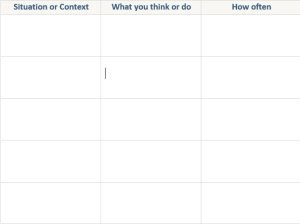
Use the table below to capture up to five specific situations where your spiral tends to start. Name actual contexts, not general categories like “at work” or “at night.”
Looking at your list, which situation pulls you into a spiral most reliably, and what makes it different from the others?
What Does It Cost You?
A spiral does not stay in your head. It spreads into your decisions, your relationships, your work, and your daily habits. Seeing where it costs you the most gives your problem real weight and makes this work worth doing. This is about the impact you can actually observe, not worst-case fears.
Check every area below where your spiral has a noticeable impact.
☐ Sleep: I lie awake or wake early because my thoughts will not slow down
☐ Work or focus: I lose time and attention to spiraling instead of the task in front of me
☐ Relationships: I withdraw, snap, or seek constant reassurance when I am caught in a loop
☐ Decisions: I stall or avoid choices because I keep replaying every possible outcome
☐ Mood and energy: I feel drained, tense, or on edge after a spiral finally winds down
☐ Other:
Of the areas you checked, which one carries the heaviest cost right now?
Your Problem Statement about how to End the Spiral Cycle
You now have two things: a picture of where your spiral shows up and a sense of what it costs you. Your task now is to compress that into one clear, specific statement. A good problem statement is not a summary of everything you wrote. It is a precise description of the single most significant pattern.
Use this formula as your guide:
“I struggle with [specific aspect of the problem] in [specific context], which leads to [specific impact].”
Three examples of workable problem statements:
I struggle with replaying conversations in the hours after a hard workday, which leaves me anxious and unable to relax all evening.
I struggle with jumping to worst-case thinking whenever I wait for a reply from my manager, which leaves me too distracted to do my job.
I struggle with looping over past mistakes when I lie down to sleep, which delays my rest and leaves me tired the next day.
Write your first version now, using the formula as a guide.
Now check your statement against these five criteria.
☐ It describes something happening now, not just in the past
☐ It points to a specific pattern, not a vague feeling
☐ It identifies a context where the spiral shows up
☐ It names an impact I can observe in my life
☐ It is focused enough to work on, not my entire history of spiraling
If you could not check all five, make some notes to tighten your statement.
What You Have Now
By completing this guide, you have produced:
☐ A map of the specific situations and contexts where your spiral shows up
☐ A clear picture of where it costs you the most
☐ A specific, workable problem statement you can carry into the next phase
These outputs are the foundation for Phase 2, so keep them somewhere you can find them. You will refer back to them.
You have done something harder than it looks. You have taken a spiral, which by its nature is fast, slippery, and hard to hold, and pinned it down into concrete terms. You now know what is happening when you spiral, where it tends to show up, and what it costs you. That is a real definition, not a vague feeling, and it is exactly what the next phase needs.
Transition to Phase 2
Phase 2 shifts from what to why. With your problem clearly defined, the next guide helps you explore why this pattern exists: what tends to set it off, what keeps it going, and which parts of it are within your control. You are still not solving anything. You are building the understanding that makes a real solution possible later. Trying to fix the spiral before you understand what drives it is exactly what has not worked before.
Next Step
You have defined your spiral in concrete terms. You know what is happening, where it shows up, and what it costs you. That clarity is the ground everything else stands on.
Begin Phase 2 with the Root Causes and Patterns Guide.
Your only task in Phase 2 is to understand what is driving this pattern. Bring your problem statement with you, since you will build directly on it. Do not try to solve anything yet. Understanding comes first.
Root Causes and Patterns Guide
Phase 2: WHY, The Problem-to-Solution Framework for Negative Thought Spirals
Introduction to Learning How to End the Spiral Cycle
This guide helps you understand why your spiral keeps happening. By the end you will have three things: a map of the root causes most connected to your pattern, an inventory of the triggers and habits that keep it active, and a clear picture of which of those you can actually influence. Together they explain why the spiral persists.
Your task here is to build understanding, not to fix anything. Keep your problem statement from Phase 1 in front of you, since everything in this guide connects back to that specific pattern. You are looking for what drives this particular spiral, not cataloging everything that has ever gone wrong.
Work through the pages in order and write your answers down. Aim for what is actually driving the pattern, not what you wish were driving it or what sounds acceptable to admit. Honesty is more useful here than a tidy story. The clearer you are about the real drivers, the more useful the next phases will be.
What Counts As a Root Cause Here
It helps to separate two things.
A trigger is what sets a spiral off in the moment: a certain email, a quiet evening, a critical comment.
A root cause sits underneath that. It is a belief, a learned habit of thinking, or a long-standing assumption that keeps the spiral available in the first place. A trigger lights the spark. A root cause is why the spark catches so easily.
These are some of the common root causes behind negative thought spirals:
- A belief that worrying enough will somehow keep a bad outcome from happening
- A habit of treating uncertainty as danger, so any open question feels urgent to resolve
- An inner standard that reads any mistake as evidence of a larger failure
- A learned pattern from earlier life where staying alert to threats felt necessary for safety
- A drive for certainty and control that no amount of thinking ever actually delivers
- A belief that you are responsible for anticipating and preventing every possible problem
You may recognize your root causes right away, or you may need the prompts that follow to surface them. Either is normal. Your job is not to produce a complete explanation of yourself. It is to identify the specific drivers most relevant to your spiral.
What Is Driving This
Start by reading your problem statement from Phase 1. The root causes you are looking for are the ones most directly connected to that specific spiral, not every contributing factor in your life. You want the drivers that explain why this particular pattern keeps returning.
Use the three sections below to capture up to five root causes. For each one, describe how it shows up in your thinking or behavior, and give a rough sense of how long it has been a factor.
1) Root Cause 2) How It Shows Up 3) How Long It Has Been a Factor
Which of these feels most central to your spiral, the one that everything else seems to connect back to?
What Makes It Worse?
Root causes explain why the spiral exists. Triggers and reinforcing patterns explain why it keeps getting activated. These are the conditions, habits, and situations that make the spiral worse in the moment or keep it from easing over time. They are not the same as root causes, and both matter.
Check every pattern below that tends to reinforce your spiral.
☐ I search online or ask other people for reassurance until the worry temporarily quiets
☐ I replay the same scenario hoping that this time I will think my way to certainty
☐ I avoid situations that might trigger a spiral, which makes them feel bigger over time
☐ I treat every anxious thought as a signal that must be resolved right now
☐ I spiral most when I am tired, hungry, or already stretched thin
☐ I keep my worries to myself, so they grow unchecked in my head
☐ I check and re-check things to feel momentarily in control
☐ I reach for my phone or busywork to numb the feeling instead of noticing the spiral
☐ Other:
Of the patterns you checked, which has the strongest grip on you right now? Describe what it looks like in practice and why it is hard to interrupt.
What Can You Actually Influence?
Not everything driving your spiral is within your control. Some root causes trace back to experiences that cannot be undone. Some reinforcing patterns involve other people or circumstances you cannot change. Spending your energy on the parts you cannot influence is one of the main reasons this kind of work stalls.
Sort what you identified in Prompts 1 and 2 into two columns: what is within your control and what is not. Honesty will serve you better than optimism here.
Within Your Control Not Within Your Control
Look at the items in the left column. Which one feels most significant to your spiral? Not the easiest to change, but the one that, if it shifted, would make the biggest difference to the pattern you defined in Phase 1.
You will decide what to do about it in Phase 3. For now, just name the one that matters most.
Your Root Cause Statement for Your Spiral Cycle
You now have a clearer picture of what drives your spiral, what reinforces it, and where your leverage is. Your task is to compress that understanding into a single statement.
Use this formula as your guide:
“The main reason I [problem behavior from Phase 1] is ___. This is reinforced by ___. The part I can influence is ___.”
Three examples of workable root cause statements:
The main reason I spiral after work is a belief that replaying conversations will help me catch a mistake before someone else does. This is reinforced by checking my messages for reassurance. The part I can influence is how quickly I reach for that reassurance.
The main reason I spiral while waiting for a reply is that I treat uncertainty as a threat I have to resolve immediately. This is reinforced by refreshing my inbox and rehearsing worst-case outcomes. The part I can influence is whether I let uncertainty sit without acting on it.
The main reason I spiral at night is a long-standing habit of scanning for problems to feel prepared and safe. This is reinforced by lying in the dark with nothing to interrupt the loop. The part I can influence is what I do in the hour before I try to sleep.
Write your root cause statement now, using the formula as a guide.
What You Have Now
By completing this guide, you have produced:
☐ A map of the root causes most directly connected to your spiral
☐ An inventory of the triggers and reinforcing patterns that keep it active
☐ A clear picture of what is within your control and what is not
☐ A specific root cause statement you can carry into Phase 3
These outputs are the foundation for Phase 3, so keep them accessible alongside your problem statement from Phase 1.
You now understand your spiral cycle in a way that goes beyond mere recognition. This means you will be able to end the spiral cycle on your own.
You know what drives it, what keeps it active, and which parts are actually in your hands. That last point matters most. Knowing where your leverage lies means the next phase can focus your effort where it can make a real difference, rather than scattering it across things you were never going to change.
I’m bestselling USA Today and Wall Street Journal author Connie Ragen Green. My goal is to help at least a thousand people to reach six-figures and beyond with an online business for time freedom and passive income and to simplify your life by focusing on how to clear the brain fog and end the spiral cycle. Come along with me, if you will and let us discover how we may further connect to achieve all of your dreams and goals. Perhaps my “Monthly Mentoring Program” is right for you.
Leave a Reply