 The First Seven Days: How to Fast-Track a New Habit and Create Momentum That Lasts and Why Habits Fail in the First Week
“You do not rise to the level of your goals. You fall to the level of your systems.” ~ James Clear
The Quiet Collapse
Most new habits do not die after months of effort. They die within days.
Think about the last time you decided to start something. Maybe it was a morning walk, a journaling practice, a new way of eating, or a daily meditation. For the first day or two, it felt good. You were motivated. You were someone new. Then by day four or five, something subtle happened. You were tired, or busy, or just not feeling it. You told yourself you would get back to it tomorrow. And then tomorrow became next week, and next week became a story you tell yourself about how you are just not disciplined enough.
This pattern is so common that most people have stopped noticing it.
The frustrating part is that the collapse does not feel dramatic when it happens. There is no single moment where you quit. You just drift, and by the time you realize the habit is gone, it has been gone for a while. You are left feeling slightly worse about yourself, slightly more convinced that habits are not your thing, and slightly less likely to try again soon. That quiet self-erosion is the real cost of a failed habit. Not the missed walk or the skipped journal entry, but the evidence you give yourself that you cannot follow through.
The good news is that this collapse is not about you. It is about the design of the first few days.
The Motivation Curve
Behavioral scientists have studied what happens to motivation after someone commits to a new behavior, and the pattern is remarkably consistent. Motivation is highest at the decision point, before you have done anything at all. It stays high through the first attempt, which feels fresh and meaningful. Then it drops. It drops quickly, and it drops hard.
By day three or four, the neurochemical rush of novelty has faded. The behavior that felt energizing on Monday feels like a chore by Thursday. Researchers sometimes call this the valley of disappointment. The work is still required, but the reward signal has quieted. Your brain, which originally lit up at the idea of the new you, now shrugs when you lace up your shoes.
This is not a character flaw. It is a feature of how human motivation is wired. We evolved to chase novelty and then move on, not to grind through identical actions day after day with no visible payoff.
The advice most people receive at this point makes the problem worse.
Be patient, they are told. Give it twenty-one days, or thirty days, or sixty-six days. Trust the process. The trouble with this advice is that it asks you to survive the exact stretch of time where your motivation is at its lowest, using willpower you no longer have, for a reward you cannot yet feel. It is a recipe for quitting.
What people actually need in the first week is not more patience. It is more momentum.
Key Insight
Habits do not fail because people are weak. They fail because the first seven days are designed around willpower instead of momentum, and willpower is the least reliable resource you have when motivation drops.
Why the First Week Decides Everything
The first seven days of a new habit are not a warm-up. They are the whole game.
In that window, your brain is deciding something important. It is deciding whether this new behavior is worth encoding. Every time you repeat the action and it goes smoothly, you are voting yes. Every time you miss, or force yourself through it resentfully, or finish feeling depleted, you are voting no. By the end of the week, the vote is mostly in. The habit either has a foothold, or it does not.
This is why the old advice to just push through is so costly. Pushing through teaches your brain that the behavior is expensive. It builds the wrong association. You want the opposite: a string of small, clean wins that tell your brain this new thing is easy, rewarding, and already part of who you are.
The rest of this book is about how to engineer that exact experience. Not through more discipline, not through better motivation, but through a different design for the first seven days. A design built around momentum.
The Momentum Principle
“Small wins fuel transformative changes by leveraging tiny advantages into patterns that convince people bigger achievements are within reach.” ~ Charles Duhigg
What Momentum Actually Is
Momentum is not a feeling. It is a physical principle borrowed into psychology because the analogy is so clean.
In physics, an object in motion tends to stay in motion. The hard part is overcoming the initial inertia. Once something is moving, less energy is required to keep it moving than was required to start it. Human behavior works the same way. The first repetition of a new habit costs the most. The second costs slightly less. By the fifth or sixth clean repetition, the action begins to feel almost automatic, and the willpower required to continue drops in a way you can actually feel.
This is why starting is always harder than continuing, and why the advice to just start sounds so frustratingly simplistic. Starting is the expensive part. If you get the start right, the middle takes care of itself. If you get the start wrong, no amount of willpower applied later can rescue the habit.
What most people do not realize is that momentum in habit-building is not about building strength. It is about building evidence. Every clean repetition in the first week is a small vote you cast for a new version of yourself. You are not just doing the thing. You are gathering proof that you are the kind of person who does the thing. That proof is what makes day eight easier than day one, and day thirty easier than day eight.
The Science of Early Wins
Researchers who study habit formation have found that the early days of a new behavior are disproportionately predictive of long-term success. Not because those days are harder, but because they set the neural and psychological conditions for everything that follows.
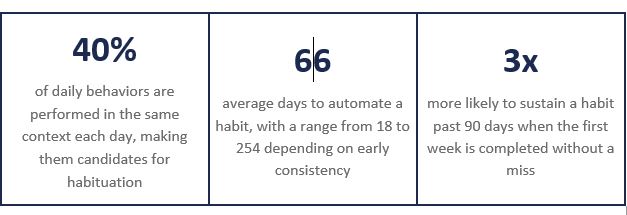
The numbers matter less than the pattern they reveal. Early consistency does not just predict later consistency. It creates it.
When your brain experiences a stretch of successful repetitions, it begins to encode the behavior as low-cost and reliable. Dopamine, the neurochemical most associated with motivation, starts releasing in anticipation of the behavior rather than only as a reward for completing it. That anticipatory release is the neurological signature of a habit taking hold. It is the point where your brain stops treating the action as an optional task and starts treating it as something that is simply part of your day.
Miss too many days early, and the opposite happens. Your brain encodes the behavior as unreliable, effortful, and optional. Every future attempt starts from a weaker position than the one before it.
The Reframe That Changes Everything
Here is the shift that makes the rest of this book make sense. You are not trying to build a habit in seven days. You are trying to build momentum.
A habit is the long-term outcome. Momentum is the short-term mechanism that makes the habit possible. When you treat habit-building as a long, grinding project, you accept in advance that most of the first month will feel hard and uncertain. When you treat momentum-building as the real goal, your job for the first week becomes simpler and far more achievable.
Your only job in the first seven days is to gather evidence that you can show up.
What momentum-first thinking changes:
- You stop measuring success by intensity and start measuring it by consistency
- You stop relying on motivation and start relying on design
- You stop trying to build a habit and start trying to build evidence
Not evidence that you can do the behavior perfectly. Not evidence that you can do it for an hour, or with intensity, or in a way that would impress someone watching. Just evidence that you can show up, reliably and quietly, for seven days in a row.
When you define success this way, the first week becomes winnable. And a winnable first week is the foundation for everything that comes next.
Engineering Your Day One Win
“If you plant the right seed in the right spot, it will grow without coaxing.” ~ BJ Fogg
Shrink the Habit Until You Cannot Fail
The single most important design decision you will make is how small to start.
Most people starting a new habit make the same mistake. They pick a version of the behavior that reflects the person they want to become rather than the person they currently are. They decide they will meditate for twenty minutes, write a thousand words, run three miles, or read a full chapter every night. Then they do it for two days, hit a low-energy evening on day three, and quit.
The fix is not to try harder. The fix is to shrink the habit until it is almost embarrassingly small.
A one-minute meditation. A single paragraph of writing. A walk to the end of the driveway. One page of reading before bed. These sound too small to matter, and that is exactly the point. A habit you cannot fail at is a habit you will repeat. A habit you repeat is a habit that builds momentum. And momentum, not size, is what determines whether the habit survives into week two.
The size of the habit you practice in the first seven days has almost nothing to do with the size of the habit you will eventually hold. Starting with a one-minute meditation does not mean you will always meditate for one minute. It means you are giving yourself the easiest possible path to seven clean repetitions, which is the foundation that lets you scale up later without losing the habit.
There are four design moves that make a day-one win almost inevitable. Each one removes a common reason habits die early.
Shrink It
Choose a version of the habit so small you cannot reasonably skip it. If you think you are starting too small, shrink it again.
Anchor It
Attach the habit to something you already do every day. Not a time of day, but an existing action that reliably happens.
Reduce Friction
Remove every small obstacle between you and the behavior. Lay out the shoes. Open the document the night before. Put the book on the pillow.
Pre-Commit
Decide in advance what the habit looks like on a bad day. The floor version, not the ceiling version, is what you commit to.
Anchor to an Existing Action
The second design move is where most habit systems succeed or fail quietly.
An anchor is something you already do every single day, without thinking. Brushing your teeth. Pouring your first cup of coffee. Putting your kids to bed. Sitting down at your desk. These actions are so reliable that you do not need motivation or a reminder to perform them. They happen on rails.
When you attach a new habit to an anchor, you inherit that reliability. You do not have to remember the new habit. The anchor reminds you. This is why attaching a habit to a time of day is usually weaker than attaching it to an existing action. Times of day vary. Your schedule shifts. But the cup of coffee happens whether it is Tuesday or Saturday.
The best anchors are specific, daily, and located near where the new habit makes sense. If you want to start stretching, pair it with brushing your teeth at night. If you want to start journaling, pair it with your morning coffee. If you want to start a short walk, pair it with the moment you close your laptop at the end of the workday.
Choose the anchor before you pick the time. The anchor is the reliable part. Everything else is negotiable.
A Simple Pre-Sprint Checklist
Before Day One begins, there are a small number of questions worth answering in writing. Not because the answers are complicated, but because writing them down forces you to commit to specifics rather than vague intentions.
Work through these five questions before Day One:
- What is the smallest version of this habit that I could not reasonably skip?
- What existing daily action will I anchor it to?
- What one piece of friction can I remove before Day One starts?
- What does the floor version of this habit look like on a bad day?
- How will I know, at the end of each day, that I showed up?
The answers do not need to be elegant. They need to be concrete. Vague commitments fail; specific ones compound. If you can answer all five questions in plain language before Day One, you have done more preparation than most people ever do, and the seven-day sprint becomes something you are ready to run rather than something you are hoping to survive.
The Seven-Day Sprint
“How we spend our days is, of course, how we spend our lives.” ~ Annie Dillard
Days One and Two, Ignition
The first two days of the sprint have one job, and it is not the job you think.
Your job is not to do the habit well. Your job is to establish that the habit happens at all. Day One and Day Two are about ignition, which means showing up, executing the smallest possible version of the behavior, and then stopping. That is it. You are not testing whether you can do this for a week. You are proving that the habit can exist in your day, attached to its anchor, at the size you committed to.
Resist the urge to do more.
On Day One, motivation will still be high. It will feel easy. You will be tempted to extend the session, add a second habit, or tell yourself that since the one-minute meditation felt good, you should do ten minutes instead. Do not. Doing more on Day One raises the floor for Day Two in a way that almost always backfires. Tomorrow you will compare yourself to today, and if today was an impressive performance, tomorrow has to match it. That is how the collapse starts.
The goal of Day One is not to feel accomplished. The goal is to finish quickly enough that Day Two feels effortless to start.
Days Three Through Five, Reinforcment
Somewhere between day three and day five, the sprint gets quietly harder.
The novelty is gone. The behavior no longer feels fresh or exciting. You may feel a flicker of resistance before the anchor fires, or notice yourself negotiating. Just this once I could skip it. Nobody would know. I will make it up tomorrow. These
thoughts are not signs that something is wrong. They are the expected middle of any behavior change, and they arrive on schedule for almost everyone.
What you do in this stretch matters more than what you do anywhere else in the seven days.
The move is to lower the bar, not raise it. If Days 1 and 2 were the one-minute meditation, Days 3 through 5 are the thirty-second meditation on a bad day. If the habit was a walk to the end of the driveway, a walk to the mailbox counts. You are not being soft on yourself. You are defending the streak, because the streak is the mechanism that is building the habit. Missing a day on Day 4 costs far more than doing a minimal version of the habit on Day 4, because a missed day teaches your brain that the behavior is optional.
Track the repetition in a way you can see. A mark on a calendar, a checkbox on a phone, a note in a journal. The tracking is not the habit. The tracking is the evidence, and the evidence is what gets you past the valley.
Key Insight
The middle of the sprint is not where you prove your willpower. It is where you prove your design. If the habit was shrunk correctly and anchored correctly, the middle should feel boring rather than heroic. Boring is the goal.
Days Six and Seven, Identity
By the end of the sprint, something has usually shifted.
You notice it quietly, not dramatically. The habit feels less like a task you are performing and more like a thing you just do. Maybe you catch yourself reaching for the journal before the coffee, or noticing that your shoes are already on before you thought about the walk. That shift is the neurological groundwork of the habit taking hold, and it matters that you notice it. Noticing it is how you turn a streak into an identity. The first seven days set the tone, and now you’re a changed person.
On Day Six and Day Seven, the work changes. It is no longer about proving you can do the behavior. It is about naming what you are becoming.
Each evening in the last two days of the sprint, answer these questions in writing:
- Did I show up today, in any form, however small?
- What did it feel like compared to Day One?
- What kind of person shows up for this seven days in a row?
- What am I starting to believe about myself that I did not believe a week ago?
The questions are not a test. They are a mirror. By the end of Day Seven, the goal is for you to be able to describe yourself in slightly different language than you used on Day Zero. Not a runner, necessarily, but someone who walks every morning. Not a meditator, necessarily, but someone who starts the day with a minute of quiet. The shift sounds subtle on paper. In practice, it is the single most important thing that happens in the entire sprint.
A habit that is attached to who you are is a habit that survives. A habit that is attached only to what you do is a habit that collapses the first time your schedule gets hard. The seven-day sprint is the mechanism for making that attachment, and Days Six and Seven are where it gets named.
Day Eight and Beyond
“We are what we repeatedly do. Excellence, then, is not an act, but a habit.” ~ Will Durant
The Never Miss Twice Rule
The sprint ends on Day Seven, but the habit does not. Day Eight is where most people quietly lose what they just built.
The mistake is predictable. After a clean week, people relax. They skip a day, sometimes for a good reason and sometimes for no reason at all, and tell themselves it does not matter because the habit is already established. What they do not realize is that the habit is not yet established. It has a foothold, which is different. A foothold can be lost as quickly as it was gained if the early repetitions stop being defended.
This is where one simple rule saves almost everyone who follows it. The rule is: never miss twice.
What never miss twice looks like in practice:
- Missing one day is recoverable and happens to everyone
- Missing two days in a row is the pattern that predicts long-term failure
- The moment you miss once, the next day becomes the most important day of the whole habit
- You do not need to make up the missed day, just refuse to let it become two
The rule is not about perfectionism. It is about recognizing that one missed day is a data point and two missed days is the start of the collapse described earlier. Almost every failed habit you have ever started died on the second consecutive miss, not the first. Defending against that second miss is worth more than any other single move you can make after the sprint ends.
Recovering Without Collapsing
When you do miss a day, and you will, the response matters more than the miss.
The instinct most people have is to overcompensate. Double the session the next day. Start a new streak. Promise themselves they will be stricter going forward. This almost never works, because it raises the cost of the habit at the exact moment the habit is most fragile. What works instead is boring. The next day, you do the smallest possible version of the habit, exactly as you did on Day One of the sprint. Not more. Not to prove anything. Just enough to re-establish that the habit still happens.
This is the same principle that carried you through Days 3 to 5 of the sprint. Lower the bar, defend the streak, let the design do the work. Recovery is not a dramatic moment of recommitment. It is a quiet return to the smallest version of the behavior, executed once, before the missed day has time to become a missed week.
Recovery days feel unsatisfying because they feel like they do not count. They count more than any other day.
The Long Game
The goal was never seven days. The goal was momentum that outlasts the sprint. A habit that survives one honest recovery is stronger than a habit that has never been tested, because you now have proof that you can miss and return. That proof is worth more than an unbroken streak.
When to Layer the Next Habit, After the First Seven Days are Complete
After the sprint, the temptation is to add more. A second habit, then a third. A full morning routine by the end of the month. Resist this for longer than feels necessary.
A habit needs roughly thirty days of consistent repetition past the end of the sprint before it is stable enough to stop demanding conscious attention. Adding a second habit before the first has stabilized means splitting your limited capacity for behavior change across two foundations that are not yet solid. Almost always, both collapse.
The better pattern is to wait. Let the first habit get genuinely boring, the kind of boring where you would have to actively try to skip it. When you notice that, and not before, run another sprint for the next habit. The second sprint is usually easier than the first, because you now have evidence that you can do this. You are no longer someone who is trying to build a habit. You are someone who has done it before and knows how.
That is the real return on the first seven days. Not the single habit you built, but the confidence that you can build the next one, and the one after that, on demand.
I’m bestselling USA Today and Wall Street Journal author Connie Ragen Green. My goal is to help at least a thousand people to reach six-figures and beyond with an online business for time freedom and passive income and to simplify your life by focusing on the first seven days. Come along with me, if you will and let us discover how we may further connect to achieve all of your dreams and goals. Perhaps my “Monthly Mentoring Program” is right for you.
Leave a Reply